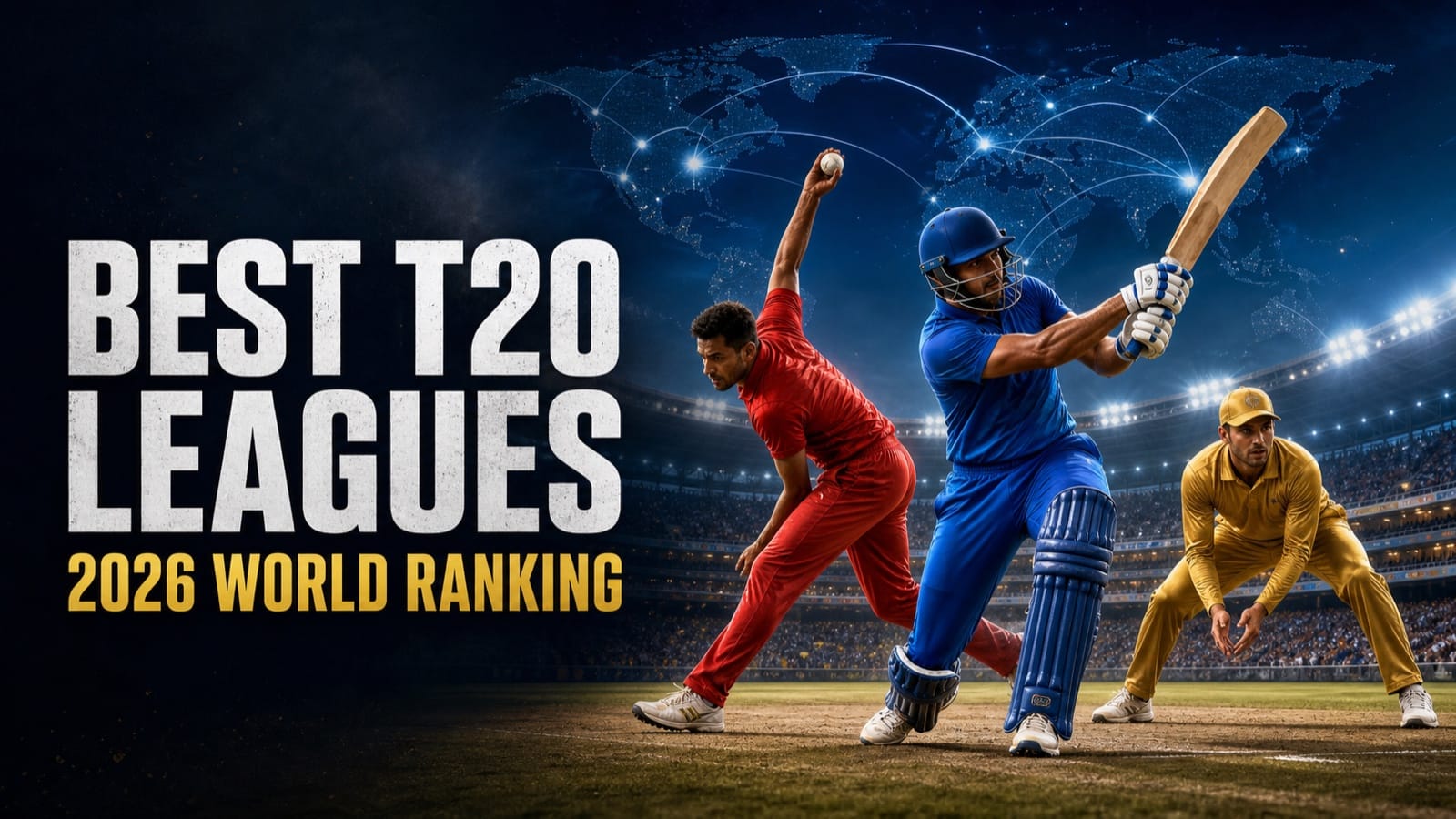
Which are the best T20 cricket leagues in the world in 2026? The answer depends on what “best” means. The Indian Premier League sits comfortably at the top for star power, audience, competitive depth and influence, but the leagues below it have built distinct identities of their own. Some offer better pathways for local players; others stand out for atmosphere, production quality or tactical innovation.
This guide ranks the leading men’s franchise T20 competitions using five practical factors: quality of players, depth of competition, global reach, strength of local talent and the league’s importance within the cricket calendar. It is not a ranking based on one television number or a single season.
Updated: July 2026. League formats, team numbers and tournament windows can change between seasons.
Top T20 leagues in the world: quick ranking
| Rank | League | Country/region | Known for |
|---|---|---|---|
| 1 | Indian Premier League (IPL) | India | Elite talent and unmatched scale |
| 2 | Big Bash League (BBL) | Australia | Strong domestic pathway and family crowds |
| 3 | SA20 | South Africa | High-quality cricket and vibrant stadiums |
| 4 | The Hundred | England and Wales | Short format, double-headers and broad reach |
| 5 | Caribbean Premier League (CPL) | Caribbean | Atmosphere, flair and regional identity |
| 6 | Pakistan Super League (PSL) | Pakistan | Fast bowling and emerging talent |
| 7 | International League T20 (ILT20) | UAE | Large overseas-player presence |
| 8 | Major League Cricket (MLC) | United States | Rapid growth in a new market |
| 9 | Bangladesh Premier League (BPL) | Bangladesh | Passionate audience and local opportunity |
| 10 | Lanka Premier League (LPL) | Sri Lanka | Platform for Sri Lankan players |
1. Indian Premier League
The IPL is the standard against which every franchise competition is measured. Its greatest strength is not merely the number of famous players; it is the density of quality across the tournament. Even an uncapped Indian player may have to compete with established internationals for a place, while teams can call on deep coaching, scouting and analysis departments.
The league has also changed how T20 cricket is played. Match-ups, flexible batting orders, specialist death bowling and the aggressive use of uncapped talent have all developed rapidly in the IPL environment. Performances can influence international selection and reshape a player’s career within a few weeks.
What makes it special: The strongest combination of elite players, competitive pressure, reach and resources.
2. Big Bash League
Australia’s Big Bash League has a clear place in the home summer and a recognisable family-friendly character. The BBL may not attract every overseas superstar, but it benefits from excellent Australian grounds, strong broadcasting and a domestic system that consistently produces skilled cricketers.
The competition is particularly useful for observing developing Australian players in defined roles. Fast bowlers learn to handle hard surfaces and large boundaries, while batters must find scoring methods that do not rely entirely on clearing a short rope.
What makes it special: A mature competition connected closely to Australia’s domestic pathway.
3. SA20
SA20 established itself quickly because the ingredients were already present: world-class grounds, a strong pool of South African players and crowds willing to make the tournament feel like a major event. Franchise links and experienced coaching groups helped it arrive with professional structures from the beginning.
Its cricket is compelling because South African conditions can reward both power and genuine pace. Young local players share dressing rooms with high-level overseas cricketers, while the best performers can push their case for international selection.
What makes it special: A lively tournament with strong local talent and consistently good playing conditions.
4. The Hundred
The Hundred uses 100 balls per innings rather than the conventional 20 overs. That difference created debate, but the competition has succeeded in presenting short-form cricket to a broad audience through men’s and women’s double-headers, prominent free-to-air coverage and city-based teams.
Tactically, sets of five balls alter how captains think about bowling changes and match-ups. The tournament also brings many leading overseas players into English conditions, where movement, changing weather and larger grounds can complicate straightforward power-hitting.
What makes it special: A distinct format and a strong combined platform for men’s and women’s cricket.
5. Caribbean Premier League
The CPL feels inseparable from Caribbean cricket culture. Music, expressive crowds and regional rivalries provide the colour, but the competition should not be mistaken for entertainment without substance. It has long offered a serious stage for West Indian players and has helped identify talent suited to the modern short game.
Slower surfaces at some venues demand better options than constant hitting through the line. Spinners, cutters and batters who manipulate unusual angles often become central to successful campaigns.
What makes it special: The strongest regional identity and atmosphere among major T20 leagues.
6. Pakistan Super League
The PSL’s reputation is closely linked to Pakistan’s production line of fast bowlers. Young quicks can emerge with pace, confidence and skills that immediately attract international attention. The league also contains technically accomplished top-order batters and inventive local stroke-makers.
Scheduling pressures and player availability can affect any franchise tournament, but the PSL’s core cricketing product remains strong. Matches between established rivals carry genuine intensity, particularly when played in front of large home crowds.
What makes it special: High-quality pace bowling and a direct route for Pakistani talent.
7. International League T20
ILT20 is based in the United Arab Emirates and features an unusually large international presence. Its location, facilities and time zone make it attractive to players and broadcasters. Teams can assemble line-ups filled with experience from several countries and franchise systems.
The long-term test is how strongly the competition develops players eligible for the UAE. A successful league needs recognisable stars, but it also needs a local story that supporters can follow over time.
What makes it special: A globally assembled player pool in a well-connected host market.
8. Major League Cricket
Major League Cricket is the most important franchise experiment in the United States. It combines established international names with US-based players and is supported by investment in venues and cricket infrastructure. The potential audience is enormous, although cricket still competes with deeply established American sports.
MLC’s progress should be measured over years rather than one season. If it can create sustainable teams, improve facilities and give domestic players more high-level matches, it may have an impact far beyond its own tournament window.
What makes it special: The chance to build professional cricket in one of the world’s largest sports markets.
9. Bangladesh Premier League
Bangladesh has a vast and emotionally invested cricket audience, giving the BPL a foundation many new leagues would envy. The tournament provides valuable roles for local players and allows overseas professionals to experience conditions in which spin and changes of pace are often decisive.
Consistency in scheduling, team identity and administration is important for the league’s future. When those elements settle, the passion surrounding Bangladeshi cricket can make the BPL a much stronger global property.
What makes it special: A major cricket nation, demanding conditions and intensely committed supporters.
10. Lanka Premier League
The LPL gives Sri Lankan players another professional stage at home. It is especially valuable for emerging cricketers who need experience against overseas opposition before they are ready for international cricket.
Sri Lanka’s variety of pitches encourages adaptable squads. Mystery spin, wrist-spin, skilful seam bowling and fluent top-order batting all have a place. The league is smaller than the leading competitions, but its importance to Sri Lanka’s talent system is substantial.
What makes it special: A focused showcase for Sri Lankan talent and subcontinental T20 skills.
How should T20 leagues be compared?
Raw viewing figures do not tell the whole story because leagues operate in very different populations and media markets. Salary figures alone can also mislead: a large contract does not guarantee a balanced tournament. A useful comparison asks several questions.
- How many high-level players are available throughout the season?
- Can the bottom teams realistically beat the leaders?
- Does the league develop players for its home country or region?
- Are schedules, teams and venues stable enough to build loyalty?
- Does the cricket create its own identity rather than imitate another league?
Frequently asked questions
Which is the number one T20 league?
The Indian Premier League is the leading men’s franchise T20 competition because of its player depth, reach, competitive standard and influence on the sport.
Which league is best after the IPL?
There is no universal answer. The BBL has history and a strong domestic system, while SA20 has quickly produced elite cricket and vibrant crowds. This ranking places the BBL second and SA20 third, but the gap is debatable.
Is The Hundred a T20 league?
No. It is a short-form franchise competition, but each innings contains 100 balls instead of 120 legal balls. It is included because it competes in the same global market and uses many similar player roles.
Why are some leagues missing?
Competitions such as the Super Smash, Vitality Blast and Global T20 Canada remain important. This list is limited to ten and weighs global profile alongside cricket quality and local impact.
Final ranking verdict
The IPL remains in a category of its own, but the wider franchise landscape is healthier when leagues are not identical. The BBL’s Australian character, the CPL’s Caribbean energy, SA20’s packed grounds and MLC’s American ambition give supporters different reasons to watch. The best long-term competition will be the one that entertains without losing its connection to local players and fans.
Reference note: Competition structures were checked against official league and national-board information. Cricket’s playing framework is governed by the Laws maintained by MCC, with tournament-specific playing conditions set by the relevant governing body.